Zionism is a “false theology,” says new Presbyterian study guide

in In the Media February 4, 2014

4th February 2014 | The Electronic Intifada, Joe Catron | Gaza City, Occupied Palestine

Zionism is a “false theology,” says new Presbyterian study guide

In five months, the Presbyterian Church (USA) will consider divestment from three US companies with Israeli military contracts, at its general assembly in Detroit.

A new study guide published by the church and compiled by its Israel/Palestine Mission Network has turned a critical eye on the Zionist ideology behind the Israeli policies the divestment measure aims to challenge.

Zionism Unsettled, as the pamphlet is titled, offers much value to any Palestine activist who has not considered the ramifications ofZionism as an ideology.

Its 74 pages sketch both Zionism’s historical outlines and its complex relationships with the Christian and Jewish faiths. A companion DVD offers further commentary.

“With Zionism Unsettled, we are hoping to shine a light on the effects of Zionism as a political ideology that is justified by appeal to selective biblical texts,” Walt Davis, co-chairperson of the IPMN’s education committee and Zionism Unsettled project coordinator, told The Electronic Intifada.

“There’s a good deal of examination of various theologies in Zionism Unsettled, but through the lens of how they have been affected by a nationalist ideology,” Davis added.

“The problem now is that the issue is no longer just a secular political ideology; it has become an ideology infused with biblical and theological justifications. Therefore it now needs to be examined through a theological lens too.”

“Cloak of silence”

Davis added that because the US is a highly religious society, “we want to open a dialogue about this symbiotic relationship that has been shrouded in a cloak of silence. This is what the churches have done in the past when oppressive ideologies like Jim Crow segregation in the US and apartheid in South Africa had become theologies of self-identity for their supporters.”

The publication of Zionism Unsettled does not mark a theological breakthrough. The Presbyterian Church (USA)’s liberal Reformed tradition has rarely offered fertile ground for the growth of Christian Zionism as a religious tendency.

As Zionism Unsettled says, “For decades the [Presbyterian Church (USA)] has opposed the evangelical blend of dispensationalism and Christian Zionism because it fuses religion with politics, distorts faith, and imperils peace in the Middle East.”

Rather, it indicates a political shift, a breach of what Jewish liberation theologian Marc Ellis calls “the interfaith ecumenical deal,” under which a significant number of Christians have supported Israel.

“In its liberal Christian manifestations, Zionism serves as a ‘price-tag’ theology providing Christians with a vehicle of repentance for the guilt accrued during centuries of European Christian anti-Semitism culminating in the Holocaust,” Naim Ateek, co-founder and director of the Sabeel Ecumenical Liberation Theology Center, writes in Zionism Unsettled.

The study guide also analyzes the disparate threads of Jewish Zionism, first cultural and political, then political and religious, culminating in the fusion of the latter two after Israel’s military occupation of the Gaza Strip, West Bank and other territories in 1967 — and the subsequent launch of its settlement project.

It also suggests the United States’ own history of settler colonialism as a crucial reason for its support, both political and religious, of the similar process of Zionism.

Myths of origin

“Israeli and American myths of origin are similar and derived from the same biblical sources,” Zionism Unsettled says, noting that “the history and ideology of settler colonialism have been so central to the political history of the United States that it is not surprising the political and religious leadership in the US has been predisposed to uncritical support for the Zionist movement.”

Much church activism for Palestine, like past divestment efforts within the Presbyterian Church (USA) and the United Methodist Church, has remained within the parameters of theOslo accords, focusing on the post-1967 occupation and aiming for a negotiated two-state solution.

Zionism Unsettled breaks this frame by also considering the ethnic cleansing of 1948, the apartheid facing Palestinian citizens of Israel and the one-state reality.

“The so-called peace process has devolved into a cover under which irreversible territorial and demographic facts on the ground are being implemented with impunity by Israel,”Zionism Unsettled begins. “Israel’s expansion into territory classified under international law as occupied has brought about a de facto one-state entity under Israeli jurisdiction.”

Later it reports “a growing consensus — except, notably, in the US and Israel — that the existing de facto one-state situation/solution is irreversible and that the Israeli form of apartheid (segregation and separate development) is becoming increasingly entrenched.”

“Colonizing minds”

But Zionism Unsettled’s focus remains on ideology, not the policies it inspires. Its authors quote the Palestinian writer and academic Nur Masalha: “Zionism was (and remains) not just about the colonization of Palestinian land, but also about colonizing minds — Jewish, Arab, European, American.”

Through their text, they attempt to decolonize one corner of America’s mainstream Protestant mind.

“What has been almost entirely absent from the mainstream conversation about Israel/Palestine is open, frank discussion about the ways in which ideology — that is, political and religious doctrine — has been a driving force of the conflict,” they write.

“Zionism is the problem,” Ateek states in Zionism Unsettled. “For Palestinians and a growing number of internationals around the world it is clear that Zionism is a false theology.”

Both a political ideology and a theology, Zionism has shaped and been shaped by the main religious traditions — Christianity and Judaism — it has engaged.

Zionism Unsettled is not an activist handbook. It is very much a work of theology, albeit political theology. Little of its content is prescriptive, rather than descriptive. Church members and others seeking practical steps to apply its knowledge will need to look elsewhere.

As the study guide was released, a delegation of Presbyterian Peace Fellowship members traveled through present-day Israel and the occupied West Bank on an Interfaith Peace-Builders (IFPB) tour. Over 12 days, its two dozen participants met activists on both sides of the green line (the internationally-recognized armistice line between present-day Israel and the occupied West Bank), posted updates to the delegation’s blog, and tweeted their experiences with the hashtag #PPFinAction.

“Moral obligation”

“The goal was to prepare a cadre of articulate, better informed, creative, passionate spokespersons from within the Presbyterian Church,” Mark C. Johnson, an IFPB board member who co-led the delegation, told The Electronic Intifada.

Delegates who have traveled to Palestine, spoken with residents and seen conditions firsthand can more convincingly say, “I believe the Presbyterian Church is legitimate in its witness when it supports the BDS [boycott, divestment and sanctions] call,’” he remarked.

“Ending one’s complicity in crime is not heroic,” Omar Barghouti, a co-founder of thePalestinian Campaign for the Academic and Cultural Boycott of Israel (PACBI) told the group.

“I think the delegation’s visit will help familiarize them, and many other Presbyterians through them, with the brutal reality of Israel’s regime of occupation, colonialism and apartheid against the Palestinian people,” Barghouti later told The Electronic Intifada.

He added that he hopes their experiences “will convince a much wider segment of the Presbyterian Church (USA) that divesting their funds from companies that are complicit in Israel’s decades-old occupation and denial of Palestinian rights is indeed a profound moral obligation.”

Barghouti added, “All Palestinians were inspired and moved to tears when a decade ago the Presbyterian Church (USA) became the first mainstream institution in the US to support divestment … For ten years, however, the church’s moves towards divestment have been held hostage to Zionist blackmail, including through so-called ‘interfaith’ groups and the unfounded, chilling and false accusations of anti-Semitism, preventing the Presbyterian Church (USA) from doing the right thing.”

Johnson also hopes the delegation’s participation will affect the divestment debate. “There is a division within the body, but the majority already have given evidence of supporting BDS and positive investment,” he said. “As long as the latter is not used to undermine the legitimacy of the former, this new wave of recruits can make a good deal of difference both prior to the GA [general assembly] and at the GA.”

On 24 January, the delegates issued a unanimous statement supporting a recommendation by the Presbyterian Church (USA)’s Mission Responsibility through Investment Committee (MRTI) for divestment.

It quotes Palestinian businessman Sam Bahour, who warned against efforts to substitute investment in Palestinian enterprises for divestment from the occupation. “Investing in our economy is an act of resistance that helps Palestinians not to give up,” he told the group. “But don’t be fooled into thinking that it will help us to end the occupation. BDS is an important tool for that” (“Presbyterian delegation unanimously supports MRTI call to divest from Caterpillar, Motorola Solutions and Hewlett-Packard,” Presbyterian Peace Fellowship, 24 January 2014).

The Presbyterian Church (USA)’s 2012 general assembly approved a church-wide boycott of Israeli settlement products by 71 percent. A motion to divest the church’s own holdings inCaterpillar, Hewlett-Packard and Motorola, all of which have business connections with the Israeli occupation, was replaced by a margin of two votes out of 666.

With divestment set to return to the Presbyterian Church (USA)’s agenda in Detroit this summer, two years of dialogue, e­ducation, and organizing by activists within the church may be nearing fruition.

Joe Catron is a US activist in Gaza, Palestine. He co-edited The Prisoners’ Diaries: Palestinian Voices from the Israeli Gulag, an anthology of accounts by detainees freed in the 2011 prisoner exchange, and is a member of the Palestine Israel Network in the Episcopal Church.

GPHRC at the Scottish Parliament


John with the First Minister Alex Salmond  
Glasgow Palestine Human Rights Campaign have just spent a very productive week at the Scottish Parliament holding an exhibition and lobbying for increased action on behalf of the Palestinian people.
We were most pleased to have a wide range of MSPs, parliamentary staff (of all levels) and members of the public (many on tours) stop to express their approval and support.
Part of those exchanges involved promoting a very impressive and critical motion initiated by Sandra White MSP (Scottish National Party), complete with a range of parliamentary backers.

S3M-3760 Sandra White: Israeli War Crimes Confirmed—That the Parliament condemns in the strongest possible terms what has come to light from the admission by Israeli troops in testimonies made to Danny Zamir, head of the Rabin pre-military academy, that civilians were deliberately targeted during Israel’s recent offensive in Gaza, including accounts of an unarmed old woman being shot, a woman and her two children being killed after Israeli soldiers ordered them from their house and into the line of fire of a sniper and soldiers clearing houses by shooting anyone whom they came across; expresses serious concern that many soldiers believed that they were fighting a religious war given the fact that booklets distributed by military rabbis had given the clear message that “we are the Jewish people, we have come to the land by miraculous means, and now we have to fight to remove the Gentiles who are getting in our way and preventing us from occupying the Holy Land”; believes that this amounts to the admission that the Israeli state is operating a programme of ethnic cleansing, and calls on the international community to initiate proceedings to bring those responsible for these atrocities to justice and for international sanctions to be placed on Israel.

Supported by: Rob Gibson, Bill Wilson, Bob Doris, Anne McLaughlin, Jamie Hepburn, Gil Paterson


It was also very heartening to have First Minister Alex Salmond come over and express his outright support for the Palestinian cause and be pictured holding a copy of the motion.
Our hope is for a development of proactive support for the Palestinian case.  Much of this is already explicit in the work of the parliamentary Cross Party Group on Palestine – as illustrated by the recent visit of cross-party members to Gaza.  We urged in our discussions with various members of all parties the need to keep a committed and united front in finding ways of pressurising Israel over its continued occupation, aggression and apartheid policies.
Although subject to reserved Westminster powers, we suggested that part of this strategy might include more critical examination of Israel’s trading practices within Scotland, in the context of Israel’s favoured EU trade arrangements.  While the parliament has no (for the present) authoritative powers or inclination to back the boycott, divestment sanctions (BDS) agenda, we’d like to see the authenticity of that gathering international strategy promoted by individual members and their parties.
We also talked of ways in which Scotland could forge closer political and cultural ties with Palestine as a way of expressing our particular support as a country.  The analogy of Scottish  solidarity during the dark days of apartheid South Africa comes to mind.
Awareness over the six decades occupation, Israel’s ethnic cleansing and the resilient suffering of the Palestinian people is gathering impressive momentum.  As a campaign, GPHRC are very aware of the emerging sympathy on the streets for the Palestinian people.  Raising the issue of their plight, and Britain’s own dirty arms-producing and political role in it, can, and should, be something that’s within the scope of a ‘parliament of the people’.
John

Israel, US locked in spat over Kerry boycott remark


Published today (updated) 03/02/2014 11:54
US Secretary of State John Kerry walks past American and Israeli
flags at Ben Gurion International Airport in Tel Aviv on January 6,
2014.(POOL/AFP/File Brendan Smialowski)
JERUSALEM (AFP) — Israel and Washington were at loggerheads on Sunday after senior Israeli figures attacked US Secretary of State John Kerry for warning of a growing boycott threat if peace talks fail.

The latest spat erupted a day after Kerry warned of the potential economic impact on Israel if the US-brokered negotiations with the Palestinians collapsed, in which he made reference to “talk of boycotts.”

His remarks sparked several outspoken reactions from senior cabinet ministers in Israel, which prompted an unusually pointed response from the US State Department urging Kerry’s critics to get their facts straight.

“For Israel there’s an increasing de-legitimisation campaign that has been building up. People are very sensitive to it. There are talk of boycotts and other kinds of things,” the US diplomat warned at a security conference in Munich on Saturday.

His remarks quickly came under attack by a series of hardline Israeli ministers, one describing them as “offensive” and another accusing the US diplomat of working “to amplify” the boycott threat.

And even Israeli Prime Minister Benjamin Netanyahu told the cabinet that “attempts to impose a boycott on the State of Israel are immoral and unjust.”

“Moreover, they will not achieve their goal.”

But US State Department spokeswoman Jen Psaki hit back at Kerry’s critics.

Kerry, she said, had demonstrated steadfast support of Israel for over 30 years, “including staunch opposition to boycotts” and his remarks in Munich had merely “described some well-known and previously stated facts about what is at stake for both sides if this process fails, including the consequences for the Palestinians.”

“His only reference to a boycott was a description of actions undertaken by others that he has always opposed,” she said.

“Secretary Kerry has always expected opposition and difficult moments in the process, but he also expects all parties to accurately portray his record and statements.”

Earlier, Intelligence Minister Yuval Steinitz lashed out at Kerry in remarks carried by Israel’s army radio.

“What Kerry said is offensive, unfair and intolerable,” he said.

“You can’t expect Israel to negotiate with a gun at its head while it discusses issues critical to its diplomatic and security interests.”

And Economy Minister Naftali Bennett of the far-right Jewish Home party, which is part of the ruling coalition but against territorial concessions to Palestinians, accused Kerry of taking sides against Israel.

“There is no nation that would give its country up over economic threats, and neither will we,” he said in a statement issued late on Saturday.

“We expect our friends in the world to stand by our side in the face of the anti-Semitic boycott attempts, not amplify them.”

BDS aims for South Africa success

A growing number of governments and businesses have recently said they will not trade with Israeli firms with ties to illegal Jewish settlements, highlighting the creeping success of a Palestinian-led boycott campaign.

The BDS movement — boycott, divestment and sanctions — works to convince governments, businesses and celebrities to cut ties with Israeli companies active in the occupied Palestinian territories, in a bid to repeat the success of the boycott which ended apartheid in South Africa.

Last week, US actress Scarlett Johansson was forced to choose between being an ambassador for Oxfam and taking on a new role as the public face of Israel’s SodaStream, which has a factory in the occupied West Bank, after the international aid group said the two roles were “incompatible.”

She resigned her position at Oxfam.

On the same day, Norway’s sovereign wealth fund blacklisted two Israeli companies involved in construction in annexed East Jerusalem.

Since January 1, the European Union has blocked all grants and funding to Israeli entities operating beyond the pre-1967 war lines, sparking growing alarm in Israel.

Kerry coaxed Israel and the Palestinians back to the negotiating table in late July 2013 for nine months of direct talks which will end in April.

Israel has announced plans for thousands of illegal settler homes since talks began.

Ma’an staff contributed to this report

‘FT’ blast on settlements will strike fear at Hasbara Central (if not among liberal Zionists and ‘glitzy blondes’)

James North and Phil Weiss on February 1, 2014 

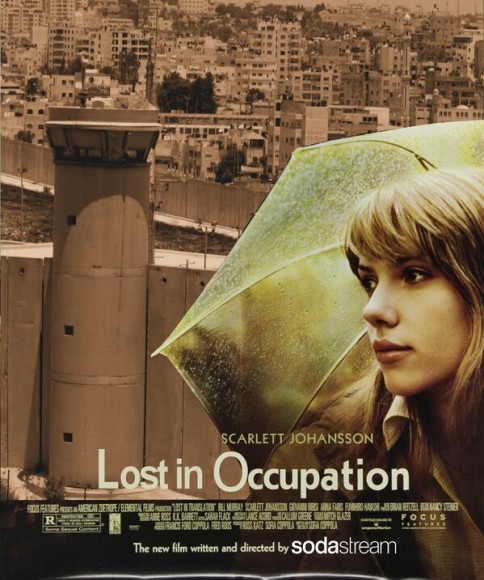
BfPZtTACMAE28TH-484x580

Lost in Translation (graphic: Stephanie Westbrook)

An editorial in this weekend’s Financial Times, the salmon-colored tribune  of London’s City, the financial district, is certainly striking terror into Hasbara Central in Israel– if not at the State Department in Washington. In forceful language that looks like it could have been lifted from a Palestine solidarity publication, the FT says that Scarlett Johansson has “accidentally turned a searchlight on an important issue–whether it is right or lawful to do business with companies that operate in illegal Israel settlements on Palestinian land…”

We cannot describe the issue any more clearly than the anonymous FT leader-writer has already done:

Ms Johansson says the company  [SodaStream] is “building a bridge to peace between Israel and Palestine”. That is naive…

And at a time when Peace Now, J Street, the Forward, Rabbi Andy Bachman, and other liberal Zionists in the US have only praise for Johansson and her settlement of choice, Ma’ale Adumim, the sprawling development on a hill east of Jerusalem that blocks Palestinian access to the city, the FT doesn’t suffer fools:

The status of the settlements is clear in international law even if Israel chooses to ignore this and expand its colonisation of Palestinian land, while ostensibly negotiating on the creation of a Palestinian state…

“You’ll note that there’s not one of Isabel Kershner’s favorite tropes in her NY Times articles—the discredited point that Israel asserts that the occupied Palestinian territory isn’t occupied (which would make civilian colonization illegal) but rather that it is ‘disputed’ (and therefore not subject to Geneva IV),” our friend Ilene Cohen points out.

The FT then refers to the EU policy of restricting funds so they don’t go to settlements.

That is not a boycott. It is the application of the law. Yet if Israel maintains its occupation, and spurns the peace terms being negotiated by US secretary of state John Kerry, such distinctions will erode. European pension funds are already starting to pull their investments in Israeli banks with branches in the settlements…

Compare the prevarications of the State Department spokesperson who says the SodaStream boycott is illegitimate and so are the settlements to the FT’s bright line distinction.

The paper doesn’t mince any words in ending its editorial, language we wish we would read in the New York Times:

It is disingenuous to romanticise settlement enterprises. The occupation imprisons thousands of the Palestinians’ young men, gives their land and water to settlers, demolishes their houses and partitions the remaining territory with scores of checkpoints and segregated roads. There are almost no basic foundations for an economy. The way to create Palestinian jobs is to end the occupation and let Palestinians build those foundations – not to build “bridges to peace” on other people’s land without their permission.

Astonishing. And important. Coming here before long, we hope.

The editorial is accompanied by a piece of analysis of Johansson’s achievement in doing the SodaStream Super Bowl ad. Peter Aspden and Reid write:

[T]his is the age of social media, in which reputations can be trashed within minutes. The anti-Johansson lobby gleefully pounced on a line from the SodaStream ad – “If only I could make this message go viral!” says the actress huskily – and has duly granted her wish with a plethora of doctored images and online slogans (“Set the bubbles free, not the Palestinians!”).

Perhaps the biggest disappointment for fans of Ms Johansson’s acting talents is the sheer banality of the ad. The star’s stiff and cliched turn is strangely reminiscent of Bill Murray’s performance-within-a-performance in her breakthrough film of 11 years ago. The cool indie beauty of that time has turned disappointingly corporate. Something appears to have been lost in translation all right.

As for the anti-Israeli lobby, it is discovering to its pleasant surprise that a sprinkle of stardust can grant instant worldwide access to a long-fought and infernally complicated campaign…

It is hard to believe that such portentous issues should suddenly become the focus of the world’s attention thanks to a glitzy blonde pushing a fizzy drink. But this is a multi-layered world. Celebrities on the make think twice – that brand “ambassadorship” you are after may turn out to be a more complicated job than you have ever imagined.

Theatrics by Israeli forces

UN presence at Kafr Qaddum demonstration leads to theatrics by Israeli forces

in Nablus, Reports February 2, 2014

31st January 2014 | International Solidarity Movement, Nablus Team | Kafr Qaddum, Occupied Palestine

In stark contrast to other Fridays, the weekly demonstration of Kafr Qaddum, in Qalqilya district, on 31stJanuary, 2014, was met with a cynical display of theatrics, in which Israeli forces attempted to portray themselves as peacemakers. The presence at the demonstration of a representative from the United Nations Office of the High Commissioner for Human Rights led to unprecedented behavior by the soldiers.

For the first time since the demonstrations began in July 2011, an Israeli officer with a megaphone made several polite requests for demonstrators to return to their homes. A female officer was also brought forward and appeals were made to the protesters not to throw stones as there was a woman present. A smaller than usual amount of tear gas was used, although several protesters were hit by canisters aimed at body height.

The weekly demonstration held at Kufr Qaddum is notorious throughout the West Bank for the high level of violent repression employed by Israeli forces. In addition to violence during the demonstrations, Israeli forces carry out regular night raids and random arrests in the town.

Protesters demand access to the road connecting the town with Nablus, which has been closed since 2003. An Israeli court ruled in November 2010 that the road should be reopened, although the military continues to block it. The illegal settlement of Qedumin, whose construction involved the theft of 4000 dunums of land from the town of Kafr Qaddum, lies along this road.

Local residents and international human rights activists spoke with the UN representative, who informed them that UN OHCHR visits in the West Bank must always be coordinated through the Israeli military high command, thus explaining the unusual behaviour on the part of the soldiers.

Photo by ISM


Settlers uproot 1000 olive saplings

Settlers uproot more than 1,000 olive saplings near Ramallah
Published yesterday (updated) 02/02/2014 22:09
(MaanImages/file)
NABLUS (Ma’an) — Jewish settlers on Sunday vandalized private Palestinian agricultural lands north of Ramallah and uprooted more than 1000 olive trees and newly planted saplings, a Palestinian official said.

Ghassan Daghlas, a Palestinian Authority official who monitors settlement-related activities in the northern West Bank, told Ma’an that a group of settlers from the Shilo settlement uprooted more than 1000 saplings in the village of Sinjil north of Ramallah.

He highlighted that the attack was the second of its kind in a week.

The trees were planted three years ago as part of a project funded by the International Red Cross Committee.

In 2012, there were 353 incidents of settler violence against Palestinians in the occupied West Bank, according to the UN Office for the Coordination of Humanitarian Affairs. Settler regularly target Palestinian olive trees for attack.

Over 90 percent of investigations into settler violence by Israeli police fail to lead to an indictment.

More than 500,000 Israeli settlers live in settlements across the West Bank and East Jerusalem, in contravention of international law.

The internationally recognized Palestinian territories of which the West Bank and East Jerusalem form a part have been occupied by the Israeli military since 1967.

Tell John Lewis: stop stocking Sodastream

John Lewis’s complacency and complicity in stocking occupation SodaStream products – despite their awareness of an international boycott campaign against the manufacturer – has been exposed. Read the EI article>

This is John Lewis’ response so far:

“ While I am sure a number of John Lewis’ customers may share these views, equally I am sure others would not and it is for this reason that John Lewis always seeks to remain non-aligned.  In our view, it is not the place of John Lewis to decide which of these views is right or wrong nor do we believe it is our place to make such a decision on behalf of our customers.

We are aware of the complex nature of the situation in Israel and the West Bank and we believe international bodies such as the United Nations, working with national governments, are best placed to resolve these issues.  Therefore, you will understand that any decision to stop stocking Sodastream products in the future would be made solely on commercial grounds by our buying teams.”

Please urge John Lewis to stop stocking Sodastream products immediately

– See more at: http://www.palestinecampaign.org/johnlewissodastream/#sthash.PJjGMUKG.dpuf

Oxfam: end ties with Scarlett Johansson

Actor, Scarlett Johansson, is currently an Ambassador for Oxfam but has just signed up to promote Sodastream.

Sodastream’s main factory is in a settlement – Ma’ale Adumim  – in the Occupied West Bank. These settlements are illegal under international law, and an obstacle to peace – therefore settlement production relies on, and supports, an activity that is illegal.

In response to letters sent far, the Oxfam CEO Mark Goldring has stated  that Oxfam  ”is opposed to trade from Israeli settlements, in which Sodastream is engaged. Israeli settlements are illegal under international law and have a devastating effect on the lives and livelihoods of the Palestinian communities that Oxfam works with. Trade with businesses operating in settlements exacerbates the ongoing poverty and denial of Palestinians’ rights that Oxfam addresses in its work.”

Significantly, he states that Oxfam “are now engaged in a dialogue with Scarlett Johansson on these important issues”.

Take action!

Please email  Mark Goldring, the CEO of Oxfam mgoldring@oxfam.org.uk

Calling for Oxfam:

  • To call for their global Ambassador, Scarlett Johansson, to immediately end her contract with Sodastream
  • or to cut ties with her following her signing up with Sodastream.

Tell Oxfam that its ethical stance is the core of its reputation and that their Global Ambassador’s relationship with Sodastream will associate them with an illegal and unethical occupation

We understand that Oxfam encouraged Oxfam’s Ambassador, Kristin Davis,  to end her commercial relationship with Ahava, an Israeli company whose dead sea products come from stolen Palestinian natural resources in the Occupied Territory of the Palestinian West Bank.  Oxfam used its good influence at that time – and we encourage Oxfam to do so again.

Arguments to use:

  • Sodastream’s main factory is in a settlement – Mishor Adumim – in the Occupied West Bank. These settlements are illegal under international law, and an obstacle to peace – therefore settlement production relies on, and supports, an activity that is illegal.
  • Israeli companies operating in the West Bank enjoy cheap land and water, confiscated from the indigenous Palestinian owners; a captive Palestinian labour force; tax benefits; and lax regulation of environmental and labour protection laws.
  • Settlement businesses damage rather than support the Palestinian economy. Draw their attention to the World Bank report which has calculated that the restrictions to land (part of the Israel’s occupation and settlement infrastructure)   results in loss to the Palestinian economy at about US$3.4 billion (October 2013)
  • SodaStream misleads consumers by labelling home beverage carbonating devices  as “Made in  Israel” despite being made in an illegal settlement.


For further information and references please visit

http://www.palestinecampaign.org/complain-to-your-local-shop-about-sodastream/


– See more at: http://www.palestinecampaign.org/scarlettjohansson/#sthash.uqkMmhGE.dpuf