http://www.jonathan-cook.net/blog/2014-02-11/aussie-tv-dares-to-show-the-real-occupation/
ISRAELI ARMY INVADE AND TERRORISE BURIN, NABLUS
On Tuesday evening a large force of the Israeli Army invaded the village of Burin, firing stun grenades, sound bombs and rubber bullets into the village until around 03:30am on Wednesday morning. The Army terrorised villages, swarming the village with soldiers and invading 7 homes. The Army justifies its terrorism of villagers as searching for youth who they allege threw Molotov cocktails at settler cars.
Burin is terrorised by the Army and the illegal settlements of Bracha and Yitzhar, that surround the village, on a daily basis. The illegal settlements are built on stolen Burin, and it’s neighbouring villages, land and in 2013 alone nearly 1500 olive trees, a vital economic source for the village, were destroyed by settlers.
بورين 11/2/2014
في تمام الساعة التاسعة مساء من يوم امس اقتحمت قوات الاحتلال الاسرائيلي قرية بورين جنوب مدينة نابلس وجاء هذا الاقتحام ضمن ادعاءات اسرائيلية على القاء زجاجتين حارقتين على سيارة مستوطن على الشارع الالتفافي المقام على اراضي قرية بورين وقد قامت باغلاق كافة مداخل والقرية و جعلت القرية منطقة عسكرية مغلقة يومنع الدخول و الخروج اليها
وقد اقتحم اكثر من مئة جندي كافة انحاء القرية وبادرو في اقتحام للمنازل بشكل عشوائي و همجي حيث تم اقتحام اكثر من 7 منازل وتم تفتيشها و التحقيق مع ساكينيها خاصة الشبان منهم
و استمر هذا لاقتحام من الساعة 9 مساء و حتى الساعة 3.30 فجرا


BDS opponents still don’t get it
- Saturday, 08 February 2014 22:19

Asa Winstanley
With the recent Scarlett Johansen affair, mainstream media coverage of the boycott, divestment and sanctions (BDS) movement reached new heights around the world.
The Hollywood actor was backed into the position of having to choose between the high-profile charity Oxfam and her lucrative new advertising contract with SodaStream – an Israeli company with a factory in an illegal West Bank settlement. The cash won out, perhaps unsurprisingly.
In the process, Johansen was forced to take a side, and to drop the “humanitarian” mask. Which side are you on, campaigners demanded. Are you against Israeli abuses of Palestinian human rights or not? In very explicitly siding with SodaStream, Johansen chose to back Israeli colonies in the West Bank. As well as being illegal under international law, the settlements mean the continued displacement of the Palestinian people from that minority of the land of Palestine now left to them.
In the course of events, BDS campaigners won an important victory, one which supporters of Israeli war crimes and apartheid still simply just don’t get: a large amount of awareness was raised in the general public. This sounds like a simple thing, but for a long term campaign like BDS, it is crucial. This in turn can, and is starting to, feed through to a real economic cost for the occupation.
My colleague Ali Abunimah at The Electronic Intifada relentlessly covered the issue, until Johansen was forced to step down from her position at Oxfam. Our coverage, and also that of other websites like Mondoweiss, helped force the issue onto the agenda of the mainstream media.
This coverage meant that more people than ever now understand the issues around settlements. More people now realise that SodaStream, is manufactured in an Israeli settlement. And this increased awareness in turn feeds back to campaigners on the ground, such as those leafleting outside John Lewis in Oxford Street on weekends.
An issue the BDS movement will face at some point in the future is the issue of settlement boycott, and what happens in the event of a US-Israeli-Palestinian Authority deal to make a pretence of “ending the conflict”.
BDS is a broad based campaign for boycott of Israel on all levels. It is by no means limited to boycotting settlement goods. Its demands are clear and simple: the end of the occupation, the implementation of the right of return of Palestinian refugees and full equality under the law.
But some of the most high-profile coverage of BDS has come about due to support for the principle of the illegality of Israeli settlements in the West Bank. This was demonstrated in the Johansen case. Oxfam’s official and stated position is that the settlements are illegal and it supports a “two state” agreement. But it does not back the BDS movement per se. Nonetheless, as a broad movement, BDS campaigners welcome support for any aspect of the campaign – which very much includes settlement boycott (as I have argued elsewhere).
In fact, the role of Oxfam was craven. According the sources we at The Electronic Intifadawere in touch with, there was an internal split within Oxfam, on transatlantic lines. Despite Oxfam’s official position that the settlements are illegal, Oxfam US did not want to be seen as making any “anti-Israel” move.
In the still (in my opinion) unlikely event the Palestinian Authority feels able to sign away Palestinian rights, and make a deal with the US and Israel declaring an “end” to the conflict, there’s not doubt the dynamics of BDS would change. Some of the indirect support from more timid and mainstream groups like Oxfam may slip away.
But the demands of the movement would remain the the same. The Kerry “peace deal” reportedly being discussed right now would certainly not bring full equality for all people living between the Jordan river and the Mediterranean sea. It would actually strike a blow against the right of return, declaring an end to the conflict with no Palestinian refugees allowed to return to their homes in what is now Israel.
And it would not even end the military occupation of the West Bank and Gaza Strip – except to declare on paper that it is ended. So BDS would continue. Whatever the future dynamics, whatever the political solutions on the ground, the three principles that underline the BDS movement are those of basic human rights and are as old as the Palestinian cause itself.
What Israel’s apologists still don’t get is that, much like the Palestinian cause itself, BDS is a popular, grass-roots and humanist campaign.
So here is some free advice for them: you can’t make the “BDS threat” go away by throwing money at the problem. Previously the Israeli government seems to have tried ignoring the problem, but that didn’t work, so now they are trying a different tack: freaking out about it.
But that won’t work either. BDS is a long term strategy for basic human rights. The only way it will go away is by fulfilling those rights.
An associate editor with The Electronic Intifada, Asa Winstanley is an investigative journalist who lives in London.
Israel demolishes Palestinian home in East Jerusalem
Published yesterday (updated) 10/02/2014 20:10

(MaanImages/file)
JERUSALEM (Ma’an) — Israeli forces demolished a Palestinian home in the East Jerusalem neighborhood of Jabal al-Mukabbir on Monday, the owner told Ma’an.
Israeli military and police officers blockaded the al-Jisr neighbor early Monday to allow bulldozers to move in and destroy the apartment building, owner Muhammad Hasan Mousa Jaafira said.
The building was constructed 18 years ago and Jaafira said he has been “trying in vain” to obtain a construction license from Israel’s Jerusalem municipality.
The demolition took place without any prior warning, although in the past he was forced to pay a fine of 30,000 shekels ($8,516) for unlicensed construction.
Israel destroyed more than 663 Palestinian properties in the West Bank and East Jerusalem in 2013, displacing 1,101 people, according to UNOCHA.
Israel rarely grants Palestinians permits to build in the West Bank, including East Jerusalem. It has demolished at least 27,000 Palestinian homes and structures since occupying the West Bank in 1967, according to the Israeli Committee Against House Demolitions.
The internationally recognized Palestinian territories of which the West Bank and East Jerusalem form a part have been occupied by the Israeli military since 1967.
Israeli ministers discuss using lawyers and Mossad to fight BDS
Israeli ministers discuss using lawyers and Mossad to fight BDS
Monday, 10 February 2014 11:20
14 46 0 60
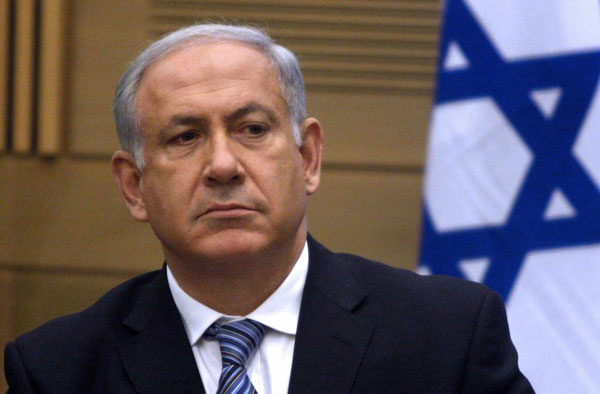
Benjamin NetanyahuIsraeli PM Benjamin Netanyahu convened senior ministers Sunday to discuss ways of fighting boycott and divestment initiatives proliferating in Europe and worldwide. Present at the meeting were Netanyahu, Foreign Minister Avigdor Lieberman, Economics Minister Naftali Bennett, and Strategic Affairs Minister Yuval Steinitz.
The main proposal under discussion was prepared by Yossi Kuperwasser, Director of the Ministry for Strategic Affairs, and other participants in the meeting included representatives of the Mossad, Shin Bet and the Coordinator of Government Activities in the Territories (COGAT).
Israeli media has reported that “the discussion was held in secret”, with an imposed “media blackout” meaning that even the offices of participating ministers were “not even officially willing to confirm that the meeting took place”.
There is a difference of opinion between Steinitz and the Israeli Ministry of Foreign Affairs (MFA), with the former pushing for a more proactive and confrontational approach. Steintz’s proposal means “invest[ing] substanial resources” in a public campaign, to the tune of “100 million shekels”. This would pay for “PR materials and aggressive legal and media campaigns against pro-boycott organizations”.
The MFA, meanwhile, is said to prefer “quieter, diplomatic channels”, judging that “a public campaign against [BDS activists] will only play into their hands, bolstering them.” According to The Jerusalem Post, Lieberman promised last week “that within some 45 days the public would see the plan Israel has in place to fight the boycotts.”
Ideas apparently discussed by senior ministers included lawsuits “in European and North American courts against [pro-BDS] organizations” and “legal action against financial institutions that boycott settlements…[and complicit] Israeli companies”. There is also the possibility of “encouraging anti-boycott legislation in friendly capitals around the world, such as Washington, Ottawa and Canberra”, and “activat[ing] the pro-Israel lobby in the U.S.” for such a purpose.
Another topic was the question of “a lack of knowledge and inefficient tracking by Israeli intelligence of pro-BDS organizations”. Although Steinitz’s Strategic Affairs Ministry “has provided the Israel Defense Forces’ intelligence department a budget of several million shekels for the purpose of bolstering military surveillance of such organizations”, reports Haaretz, “the need for the prime minister to instruct the Shin Bet Security Service and the Mossad on the efforts is likely to come up.”
WATCH: Settlers assault Israeli in West Bank, tell soldiers to shoot
WATCH: Settlers assault Israeli in West Bank, tell soldiers to shoot
On Saturday morning, Israeli Ta’ayush activists accompanied Palestinian residents of the village of Shweika in the South Hebron Hills to their grazing and farm lands in a valley near the illegal Eshtamoa outpost. According to Guy, a veteran activist and documenter, settlers and Israeli soldiers have been obstructing or preventing access to the land in recent weeks, despite the fact that Israeli authorities recognize the valley as private Palestinian land and have restricted any Israelis from entering it.
Just before 11 a.m., 10-15 settlers came down from the outpost into the valley – most of them with their faces covered to avoid identification – and began throwing stones, some of them using slingshots. As can be seen in several videos below, three of the settlers violently assaulted one activist, with one of the settlers using a club. Watch the second video to the very end: You can see a soldier slowly making his way up to the settlers who run off after the attack. He did not try and stop them, does not run after them, and in fact pats one on the shoulder in a friendly, not disciplinary manner. This kind of dynamic not only makes the double standard in treatment of Palestinians clear, but shows that it is in fact the settlers who run the show in these parts.
The activist was badly bruised on his arms, legs and back. According to Guy, soldiers in the area looked on and did nothing to prevent it, nor did they detain the settlers or demand to see their faces and identify them. Guy, along with the victim and another activist, went to the Kiryat Arba police station to file a complaint. The police said the incident will be investigated.
Two of the soldiers who were in the valley at the time of the incident also happened to be at the police station. They told Guy that an armed settler screamed at them to shoot at the Israeli Ta’ayush activists, threatening to do so himself if they refused his order. Unfortunately, based on over a decade of Ta’ayush experience with similar incidents, the chances that these settlers will be brought to justice is next to nil, despite clear evidence.
Several Israeli news sites reported on the incident in Hebrew. According toHaaretz’s report, the IDF Spokesperson responded by stating that the video was “tendentiously edited” and that the soldiers on the scene responded as per protocol: they “distanced the residents” [presumably they mean settlers] and called the police to investigate the suspects.
As far as Guy knows, no suspects were taken into custody – certainly not at the time of the incident, when it was most crucial.
Read more:
Israel fights back as boycott movement gains strength
- Date

The story of an actress and a drinks company highlights a growing movement against settlements.

Boycott: Associate Professor Jake Lynch; actress Scarlett Johansson. Photo: Getty Images
As Route 90 winds its way through the Jordan Valley, a spectacular desert landscape rises beyond the ancient city of Jericho. Vast date plantations, farms and greenhouses attached to dozens of Israeli settlements cover the lush low-lying agricultural lands below.
Producing grapes, dates, tomatoes, eggplant, capsicum and herbs, most of it for export, the settlers’ agricultural enterprises cover 3300 hectares and are valued at 500 million Israeli shekels ($158 million), according to the Jordan Valley Regional Council.
But the settlement enterprises stretch beyond the Jordan Valley, throughout the Israeli-occupied West Bank, all of it beyond the so-called Green Line that divides Israel and the Palestinian territories. All of it is considered illegal under international law – a point Israel has disputed for decades.
 Building blocks: Ma’ale Adumim settlement in the West Bank. Photo: Reuters
The Israeli company SodaStream is in an industrial park attached to the third-largest settlement in the West Bank, Ma’ale Adumim. Just as conflicted is the Hebrew University’s Mount Scopus campus, part of which human rights groups say has been built on land Israel appropriated from Palestinian owners and then illegally annexed.
Advertisement
And it is here that the lives of Hollywood actor Scarlett Johansson and University of Sydney academic Jake Lynch intersect in the debate over the growing economic, cultural and academic boycott of Israel. Both have become symbols on opposing sides of the international Boycott, Divestment and Sanctions movement.
Johansson stood down as ambassador to the international charity Oxfam, unable to reconcile Oxfam’s opposition to all trade from Israeli settlements with her role as spokeswoman for SodaStream, while Lynch, the director of the Centre for Peace and Conflict Studies, is facing court action in Australia this month over his decision to participate in the boycott of an Israeli university.
 A sample: One year of boycott and divestment.
Inspired by the boycott campaign against apartheid in South Africa that was designed to pressure the government to overturn racial segregation, the BDS movement has both powerful backers and detractors. Formed in 2005 by 170 Palestinian individuals and civil society groups, it calls for the boycott of Israeli companies and products that profit from Israel’s occupation of Palestinian territory until it meets its obligations under international law. For the BDS campaign, this means Israel must end its occupation, recognise the equal rights of Arab citizens of Israel and respect the right of return of Palestinian refugees (a major stumbling block over decades of failed peace talks between Israel and Palestine).
Its detractors label the movement anti-Semitic and say it is targeting Israel’s right to exist as opposed to its policies, while its supporters say it is a legitimate, non-violent form of protest against Israel’s four-decade long occupation of Palestine.
Such is the concern over the movement’s increasing momentum that at least two senior Israeli cabinet ministers, as well as the Prime Minister, have issued statements on the boycotts in recent days. Finance Minister Yair Lapid told Army Radio on Monday that the boycott could cost the economy 11 billion Israeli shekels and nearly 10,000 jobs. He noted Germany was talking about banning settlement products and warned ”it will hit the pocket of every Israeli if we don’t deal with it” – ”it” being a peace deal with the Palestinians. Lapid’s comments appeared to be partly prompted by US Secretary of State John Kerry, who warned the status quo of the Israeli-Palestinian conflict ”cannot be maintained”.
Prime Minister Benjamin Netanyahu responded bluntly to the idea of boycotts, describing them as ”immoral and unjust” in his weekly cabinet meeting. Meanwhile, Foreign Minister Avigdor Lieberman told local reporters a new ”inter-ministerial” team has been established to fight the boycott of products produced beyond the Green Line.
It is probably not Lynch’s act of academic boycott from Australia or Johansson’s split from Oxfam that has Israeli political and business leaders most worried but the implementation of new European Union guidelines that explicitly state no EU grants, prizes or financial instruments, such as loans, can be issued to Israeli entities operating beyond the Green Line, including the West Bank, East Jerusalem and the Golan Heights. The British government’s warning to businesses in December over trading with Israeli settlements in the West Bank has also raised concern.
It is not just governments that are toughening their stance on settlements. Israel’s constant settlement construction was also pushing private companies to boycott their products and services, said Lars Faaborg-Andersen, EU ambassador to Israel.
Pedalling in the opposite direction, the Australian government representatives at the United Nations in November withdrew support for a UN resolution to stop ”all Israeli settlement activities in the occupied territories”. Last month, in another reversal of policy, Foreign Minister Julie Bishop said: ”I would like to see which international law has declared [Israeli settlements] illegal.”
On Wednesday Israel confirmed a further 349 new units would be built in East Jerusalem, while settlement monitoring group Peace Now says plans for 5349 new units had been announced since peace talks restarted in July.
While the BDS movement may have appeared marginal and extreme when it began eight years ago, it is now impossible to ignore, says Dahlia Scheindlin, a public opinion analyst based in Tel Aviv and an adjunct lecturer at Ben Gurion University and Tel Aviv University.
Boycott puts the issue of ending the occupation and the conflict back on the map, Scheindlin says, when nothing else seems to have worked. ”I do consider boycott a non-violent tactic and I reject the argument … of saying that ‘boycott is economic violence or political violence,’ ” she says. ”Boycott doesn’t kill people. It barely puts anybody out of a job.”
Increasing numbers of performers have also cancelled appearances in Israel following pressure from the global boycott movement. ”It is very effective, it hits a very mainstream group, it is like a personal insult to every Israeli who ever bought a ticket for Elvis Costello or Roger Waters, for anyone who bought tickets for shows that were cancelled.”
In December, the 5000-member American Studies Association made waves when it passed a resolution that bans ”formal collaborations with Israeli academic institutions, or with scholars who are expressly serving as representatives or ambassadors of those institutions”. That followed the Association for Asian American Studies resolution last April that also endorsed a boycott.
In the past fortnight alone, the world’s largest sovereign wealth fund, the Norwegian Government Pension Fund Global, has been barred from investing in two Israeli companies due to their ”serious violations” of individual rights, while Denmark’s largest bank added an Israeli bank to its list of banned companies. Soon after, Danskse Bank, which had already withdrawn its investment from Africa Israel Investments and Danya Cebus, announced it was banning investment in Bank Hapoalim because the latter is funding settlement construction.
An Israeli Ministry of Foreign Affairs spokesman, Yigal Palmor, described the Danskse Bank’s decision as ”preposterous” and part of what ”appears to be an Israel-bashing fashion”.
There is no doubt the boycott is a blunt tool, and it can leave those against whom it is directed feeling distinctly uncomfortable.
The Hebrew University academic who approached Lynch seeking permission to use his name on an application for the Sir Zelman Cowen fellowship program, Dan Avnon, has spent much of his career promoting co-existence between Jewish and Arab Israelis.
Lynch, one of several people approached by Avnon, declined the request, citing a boycott of institutional links with universities in Israel, under the Palestinian Campaign for the Academic and Cultural Boycott of Israel, which is part of the broader BDS movement.
Avnon did not want to be interviewed for this story, but said he would speak to the media once he had taken up a position in the University of Sydney’s Institute for Democracy and Human Rights next month.
Lynch says the boycott movement has only ever been about institutional collaboration. Just like there was no non-political way to play sport with apartheid South Africa, he says, there is ”no non-political way to engage in institutional collaboration with Israeli universities”.
But those arguments hold no sway with Rivka Carmi, the president of Ben Gurion University of the Negev, who says an academic boycott creates losers on all sides. ”Academic work is all about collaboration and co-operation and free movement from one place to another – participating in conferences, joint research and joint teaching programs,” Carmi says. ”An institution that is being boycotted is being isolated from all of this.”
Ben Gurion University, which has about 1000 Arab, Bedouin and Palestinian students, as well a handful of Arab and Bedouin faculty members, is also increasingly collaborating with Palestinian academics, she says.
”For those of us who speak in favour of free speech, academic freedom and human rights, the boycott movement is really undermining all of this and damaging these efforts of collaboration.”
For Scheindlin, the attempt to prosecute an academic who is participating in a boycott, as the Israeli organisation Shurat HaDin is attempting to do to Jake Lynch in Australia’s Federal Court, is more damaging than the boycott itself.
”Trying to prosecute somebody under anti-discrimination laws for refusing to support an academic – that to me is a more dangerous and insidious form of silencing,” she says.
Lynch was unable to comment on the case, which is due for a directions hearing on February 12.
In the meantime, since the furore over Johansson’s involvement with SodaStream, the company’s share price fell 3.3 per cent to $US35.34 ($40), its lowest since November 2012. Chief executive Daniel Birnbaum defended his company over the weekend, saying it employed 500 Palestinians out of its 1300-strong workforce.
Omar Barghouti, a Palestinian human rights activist and co-founder of the BDS movement, said that many Palestinians were ”left with no choice but to work for complicit Israeli companies to be able to put food on the table for their families”.
A long, bloody January in Gaza
in Gaza, Reports February 5, 2014
5th January 2014 | International Solidarity Movement, Rosa Schiano | Gaza, Occupied Palestine

Civil Defense crews work to clear the rubble left by an Israeli airstrike on 31 January. (Photo by Rosa Schiano)
It was a bloody beginning of the new year for the Palestinians of Gaza who, in addition to suffer from more and more difficult socioeconomic conditions, continued to face Israeli military violence.
During the month of January, there have been many attacks in the areas along the separation barrier surrounding the Gaza Strip, several incursions of Israeli military vehicles into Palestinian territory, precision air strikes, and almost constant attacks by the Israeli navy against fishermen.
The “bloody Fridays,” attacks against the youths of the popular resistance
Recently popular resistance has grown in the Gaza Strip. Every Friday hundreds of young Palestinians gather near the al-Shuhada cemetery, east of Jabaliya, in the northern Gaza Strip. Sometimes they throw stones at Israeli soldiers and try to place Palestinian flags on the fence that separates the Gaza Strip from the land occupied by Israel in 1948. Israeli forces open fire indiscriminately at these unarmed young people, sometimes injuring or killing them. In January, two young Palestinians, included a child, were killed during the popular demonstrations. And at least 14 young Palestinians were wounded by gunfire in the course of these events. In the majority of cases, injuries to their lower limbs were reported.
On 2 January, Adnan Jamil Shehda Abu Khater, age 17, went to the al-Shuhada cemetery with some friends after school. The youths were about 500 meters from the fence. Israeli forces opened fire and Abu Khater was wounded by a bullet in the pelvic area. He died the following day.

Thaer Mohammed Rab’a. (Photo by Rosa Schiano)
On 3 January, in the same area, Israeli forces opened fire at a group of youths about 200 meters from the fence. Khaled Ibrahim Ouda, age 21, was injured by a bullet in the right leg. The same day, Thaer Mohammed Rab’a, age 25, was injured by a bullet in his left side while he was 300 meters from the fence. “They were competing in getting closer to the fence,” one of Thaer’s relatives said.
On 11 January, in the same area, the Israeli army opened fire at a group of youths who were close to the fence. Mahmoud Atef Mohammed Lubbad, age 22, was wounded by a bullet in the left leg. On January 24th , the Israeli army opened fire at a group of youths who threw stones at the soldiers. Five young civilians were injured. Mo’aaz Munir Salman Ghabit, age 18), reported a moderate wound to his right thigh; Abdullah Mohammed ‘Abdullah ‘Awad, age 22, reported a moderate injury to his right hand and fracture; Salem Nafez Salem Abu Aser, age 21, reported a light injury to his right foot; Mohammed Naser Hasounah Abu Qamar, age 18, reported a light wound in the left arm; and Yehia Mahmoud Omer al-Jammal, age 20, reported a light wound to his back.

Belal Samir Ahmed ‘Aweidah, shortly before he was shot and killed by an Israeli military sniper. (Photo by Akram ‘Aweidah)
In the same day, a group of young Palestinians was gathering in an area north of Beit Lahia. They approached the border and throw some stones at the soldiers. Belal Samir Ahmed ‘Aweidah, age 19, from Beit Lahia, was killed instantly with a bullet to his chest. His mother described how her son was killed.
“We had lunch,” she said. “It was our last lunch. Then he dressed. I asked him: ‘Where are you going?’ ‘I will do a tour with some friends’, he said.”
Belal, along with other youths, was spending Friday afternoon taking photos near the fence and “looking at our occupied lands on the other side of the barrier,” his cousin Akram said. A sniper fired a bullet into his chest.
“I heard a bullet,” he said. “We ran away. Belal was running with me. He was running with the bullet in his chest. Then he told me, ‘Akram, Akram, I’m wounded,’ and fell on the ground.”
Akram showed us photos he had taken of Belal before he was killed.
On 31 January, the last Friday of the month, about six youths were injured close to the cemetery east of Jabalyia. Two of the wounded were hospitalized at Kamal Odwan hospital in Beit Lahia. Moaz Al Tlalqa, age 21, was wounded in the right thigh. The bullet caused a comminuted fracture.
“We want the end of the siege and we want to live like the other people in the rest of the world,” he said later. The second injured Palestinian, Mahmoud Muharram, age 24, had tried to reach the body of another wounded young man who was lying 20 meters from the fence. The soldiers told him to go away and to leave the body of the young man. Mahmoud refused. A soldier fired a bullet at his left leg.
“The soldiers took the Palestinian flag that we placed on the fence and stepped on it,” Mahoud said. Then he added: “This land was wet with blood more than water.”
In the courtyard of the hospital, several youths present Friday at the demonstration, included a young man injured the previous week, had gathered.
“Next Friday, I’m going to place the Palestinian flag over the fence,” one of them said.
“It’s dangerous,” an international activist said.
“Whatever is written in the sky, we will face it,” the young man replied.
Airstrikes and extrajudicial killings
In January, the Israeli air force carried out two attacks on agricultural and empty lands. Three attacks targeted Palestinian resistance sites. In one, a three-year-old child was injured by shards from the broken window of her house in Nuseirat. Two UNRWA schools and more than 20 houses were damaged in the same attack.
Extrajudicial assassination attempts are considered illegal under international law.
On 9 January, an Israeli warplane fired a missile at a motorcycle rickshaw, or “tuk-tuk,” driven by two members of the military resistance east of Khan Younis. The two men were wounded and windows of the adjacent houses were damaged. A three-year-old child, Heba Abdullah al-Ghalban, was injured by shards of glass.
On 19 January, an Israeli drone fired a missile at a motorcycle driven by an activist of the al-Quds Brigades, the armed wing of the Palestinian Islamic Jihad movement, in al-Saftawi street in the town of Jabaliya. The activist was seriously injured and a an eleven-year-old child was injured by shrapnel.
On 22 January, in another extrajudicial execution attempt, an Israeli drone fired a missile at a civilian car in Beit Hanoun, in the northern Gaza Strip. Both passengers, Ahmed Mohamed Khalil al-Za’anin, age 21, a member of the resistance, and his cousin Mohammed Yousif Ahmed al-Za’anin, age 22, were killed.

(Photo by Rosa Schiano)
On 31 January, at about 2:40 am, Israeli warplanes carried out airstrikes in Rafah Safena, north of Gaza City, and on a building near Sheikh Zayed, in the north of Gaza Strip. In the latter case, many animals bred in the bombed structure were killed. During the same period, Palestinian armed resistance groups have launched several rockets toward Israeli territory, and the Israeli Defense minister threatened a new military offensive if the Palestinian government in Gaza does not prevent the launch of rockets.
Aggression against fishermen
In January, the Israeli navy carried out at least 13 attacks against Palestinian fishermen during which fishermen were forced to leave their work. All the attacks occurred within three nautical miles, except for one within six nautical miles. Most of the attacks took place in waters off the northern part of the Gaza Strip.
Three fishermen were captured, included a child. During the detentions, the fishermen were interrogated, asked for their personal information and about places and people in Gaza. Their boats were confiscated.
Incursions
Israeli military vehicles carried out several incursions and “leveling” operations on Palestinian agricultural lands. In several cases the army opened fire at farmers and other civilians in Khan Younis and Beit Hanoun, forcing them to leave the area. In one incident, a civilian was wounded in Beit Hanoun 300 meters from the fence.
Israel ‘okays plans for over 550 East Jerusalem settler homes
Published today (updated) 05/02/2014 19:32

Palestinians and Israeli activists hold a banner reading “No peace
with settlements” as they take part in a demonstration near the
West bank town of Jericho, on January 31, 2014.(AFP/Ahmad Gharabli)
with settlements” as they take part in a demonstration near the
West bank town of Jericho, on January 31, 2014.(AFP/Ahmad Gharabli)
JERUSALEM (AFP) — Israel on Wednesday pushed forward with plans to build more than 550 new homes in illegal settlements in annexed East Jerusalem, the city council said.In a statement listing “building permits that were approved” during a local planning committee session, it said permits were granted to private contractors to build 386 units in Har Homa, 136 units in Neve Yaakov and 36 units in Pisgat Zeev.
Issuing construction permits is one of the last stages before construction begins, with building likely to start in the coming weeks, Israel’s Peace Now settlement watchdog said.
Israel and the Palestinians began a round of direct peace talks at the end of July with the aim of reaching an agreement within nine months.
But the US-led negotiations have been overshadowed by Israel’s refusal to rein in construction plans on occupied Palestinian land.
Israel captured East Jerusalem during the 1967 Six-Day War and later annexed it in a move never recognised by the international community.
It considers all of Jerusalem its “eternal, undivided” capital and does not see construction in the eastern sector as settlement building.
Some 350,000 Jewish settlers live in West Bank settlements, in addition to another 200,000 Israelis settled in occupied and annexed East Jerusalem.
The international community views all settlement building on occupied Palestinian land as illegal.
Ma’an staff contributed to this report
SodaStream Drops Amid Sanctions Over Jewish Settlements
By Elena Popina Feb 3, 2014 11:01 PM GMT

An employee uses a forklift truck to prepare pallets of SodaStream products for export… Read More
SodaStream International Ltd., the Israeli maker of home soda machines with a factory in the West Bank, sank to the lowest since 2012 in New York amid growing criticism for businesses operating in a territory that Palestinians seek for an independent state.
SodaStream slumped 3.3 percent to $35.34 in New York, the lowest since Nov. 20, 2012. The stock plunged 26 percent on Jan. 13 after SodaStream reported worse-than-forecast preliminary earnings for 2013.
U.S. Secretary of State John Kerry, who is leading U.S. efforts to reach an Israeli-Palestinian peace deal, cautioned Israel at the Munich Security Conference on Feb. 1 about an “increasing delegitimization campaign” that includes “talks of boycotts.” Actress Scarlett Johansson publicly split with Oxfam last week after the U.K.-based charity criticized her role as a spokeswoman for SodaStream, because of its plant in a settlement in the West Bank.
“John Kerry made comments about the economic damage of the sanctions and this scared investors a lot,” David Kaplan, an analyst at Barclays Plc who has a buy recommendation for SodaStream, said by phone from Tel Aviv. “On top of that, they missed earnings without clarifying why they had missed earnings and what they plan to do going forward. The stock will be down until they figure out a way to restore confidence.”
Yonah Lloyd, SodaStream’s chief corporate development and communications officer, declined to comment on the stock move in an e-mailed statement.
‘Headwinds’ Expected
SodaStream Chief Executive Officer Daniel Birnbaum defended his company to journalists yesterday during a press tour of the plant, which employs 500 Palestinians, 450 Israeli Arabs and 350 Israeli Jews.
“We’re not a settlement, we’re a factory,” Birnbaum said.
SodaStream reported on Jan. 13 preliminary adjusted net income of $52.5 million for 2013, below the $65.4 million median estimate in a Bloomberg survey of four analysts. Chief Executive Officer Daniel Birnbaum said after the earnings were released that he expects some “headwinds” to extend into this year, overshadowing the Jan. 10 announcement that Johansson will become the face of SodaStream’s new marketing campaign.
The Hollywood actress touted a SodaStream machine in a Super Bowl ad.
Boycott Debate
Oxfam said Jan. 30 that it accepted Johansson’s decision to step down because of her work with SodaStream. The anti-poverty organization is opposed to all trade from Israeli settlements, which it says are illegal under international law, according to its website.
The boycott debate comes after pro-Palestinian activists scored several successes in a campaign to blacklist businesses operating in the West Bank and east Jerusalem, land occupied by Israel since 1967 and claimed by Palestinians for a future state.
Dutch asset manager PGGM, which oversees more than 150 billion euros ($203 billion), announced last month it would stop investing in Israeli banks because of their financial operations in the settlements. Norway’s sovereign oil fund last week renewed an investment ban on two Israeli construction companies that build in the West Bank, Africa Israel Investments Ltd. and Danya Cebus Ltd.
To contact the reporter on this story: Elena Popina in New York at epopina@bloomberg.net
To contact the editor responsible for this story: Tal Barak Harif at tbarak@bloomberg.net